

Where are the doctors? Tracking vaccine access across the South
When we talk about immunization barriers, we often point to social drivers of health: transportation, housing, child care, and unpredictable work schedules. It is incredibly difficult for parents to get their children to well-visits when the healthcare system is not built to accommodate their daily reality.
But behind these daily hurdles lies a simpler, foundational question: Which of our communities even have enough doctors to start with?
Mapping provider access
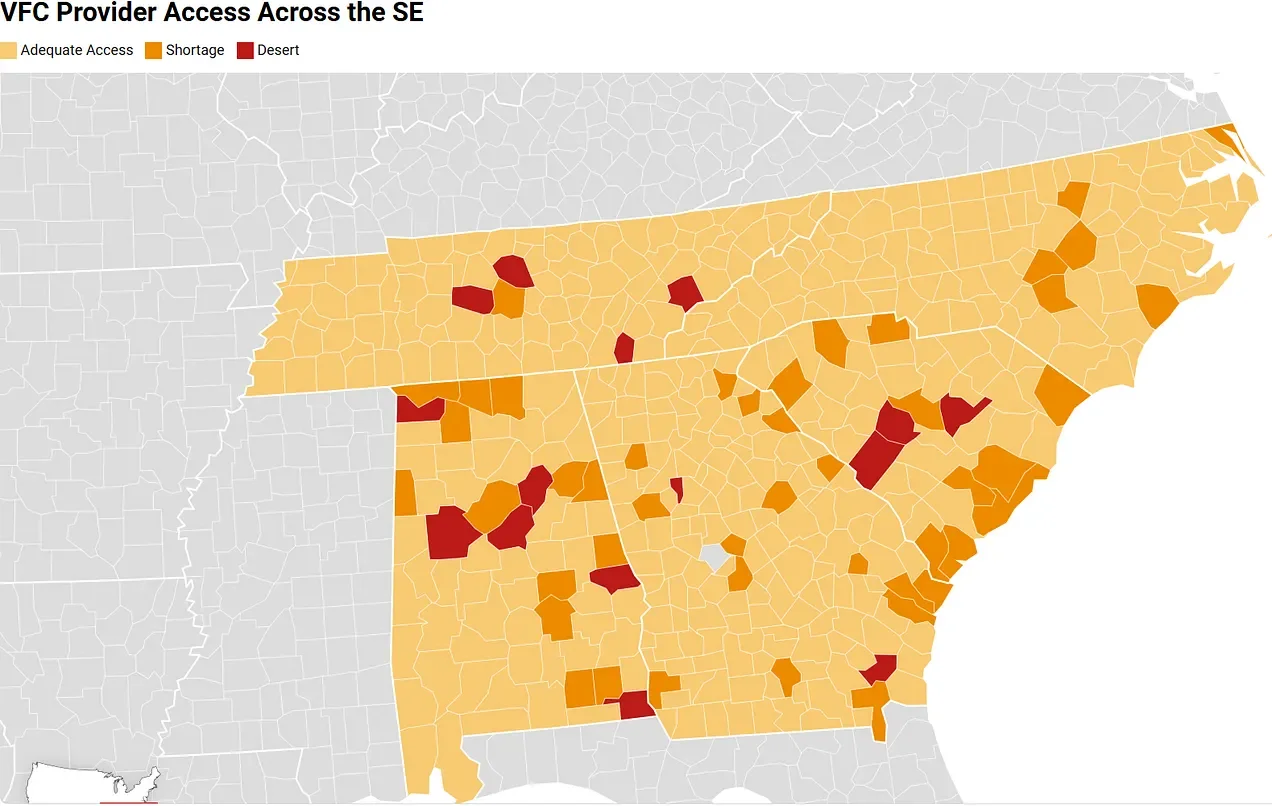
At the Southern Alliance for Public Health Leadership, we wanted to answer that foundational question. We recently mapped provider access across our five states.
This looks at the ratio of Vaccines for Children (VFC) providers—clinics designed to serve Medicaid, uninsured, and underinsured children—to the population of children five and under in each county.
How it breaks out:
Adequate access
1 VFC provider for every 665 kids under five or less.
Provider shortage
1 VFC provider for every 999 kids under five or less.
VFC desert
1 VFC provider for every 1000 kids or greater.
Three main takeaways from the data
The biggest gaps are not where you might expect
When we think of healthcare deserts, we usually picture our smallest rural towns. Our mapping revealed a different reality. The most severe provider shortages are frequently in medium-sized suburban and urban communities.
Note: Places like Tuscaloosa and Lee Counties in Alabama, and Lexington County, South Carolina, face some of the most significant access problems in our region.
Deliberate investment erases deserts
Policy choices matter. North Carolina currently has no "VFC Deserts" in our mapping. This is not an accident; it is the direct result of intentional local investment in public health and rural healthcare, coupled with Medicaid expansion.
When states actively invest in health infrastructure, access follows.
Data provides a common language, not a perfect picture
This map is our starting point. A county might look fully covered because it has three VFC providers, but if all three are clustered in the county seat with limited hours, true access remains fractured.
Still, establishing this ratio gives us a shared metric to identify and discuss vaccine access for kids across the South.
Moving forward: three recommendations
Mapping the problem is only useful if it leads to action. To resolve these access issues and support the providers doing this critical work, we recommend three immediate shifts in practice and policy.
Expand pharmacy access
Allow pharmacists to administer VFC vaccines to younger children. This immediately multiplies the number of access points for busy families, leveraging existing community infrastructure.
Subsidize the setup
Make VFC enrollment easier. The VFC program requires strict storage and reporting. We should help clinics get set up by providing the upfront funding and technical assistance needed to meet these requirements.
Raise the reimbursement rate
Currently, most state providers receive roughly $20 per vaccine administered. If protecting our children is a true priority—and it is—the providers doing the work deserve fair compensation.
Closing these gaps will require all of us—public health leaders, policymakers, and community partners—working from a shared understanding of where the needs truly lie. We want to hear what you are seeing on the ground in your own communities.
Let's keep building a healthier South, together.