


TennCare Administrative Barriers
for Moms and Babies
This report was drafted based on available information and data sourced throughout this document. The Southern Alliance for Public Health Leadership (SAPHL) convened a series of sessions over from May of 2026 through September of 2026 with subject matter experts and stakeholders across the state of Tennessee to collect their feedback and ideas on both where the system was breaking down and how it could work better.
1 Policy Landscape and Changes
Medicaid is a crucial and foundational safety net. Despite its vital role, significant administrative and procedural barriers continue to hinder eligible families from accessing and maintaining coverage. The recent Medicaid unwinding period underscored these systemic vulnerabilities, as half a million Tennesseans lost their health coverage.
Total Coverage Loss
Tennesseans lost health coverage during the unwinding period.
Procedural Terminations
Lost coverage for purely procedural reasons rather than a change in actual eligibility.
While user-side barriers like limited broadband and complex portals are significant, recent audits and federal litigation highlight that state-side technical failures are a primary driver of this coverage loss. The state's automated eligibility system (TEDS) frequently mismanages documentation, fails to utilize data already on file, and generates defective notices. Consequently, families often lose their maternal and pediatric coverage due to systemic administrative errors rather than a genuine change in their eligibility status.
For moms and babies it also represents a breakdown in the essential continuous care for moms and babies during their most vulnerable stages. It’s also crucial for creating a sustainable healthcare system; every dollar not covered by Medicaid translates into both a health and economic cost for families, for providers, and for healthcare systems. It’s also particularly important and noteworthy for health departments, which primarily serve women and children and where Medicaid is often the primary insurer for clients.
New federal requirements and bureaucratic layers around eligibility, verification, and reporting compound the existing workload pressures and staffing vacancies that are already overwhelming local DSS offices. Beyond general administrative burdens and procedural bottlenecks, families frequently navigate glitchy interfaces and confusing communications—often exacerbated by limited rural broadband access. For example, digital enrollment portals often rely on credit-reporting agencies for identity verification. This inherently disadvantages low-income applicants who lack an established credit history, effectively barring them from digital enrollment and forcing them into backlogged phone or in-person systems.
Furthermore, while Tennessee (like other states across the South) took the vital step of extending TennCare postpartum coverage to 12 months in 2022, a severe "postpartum cliff" remains at the one-year mark. Because Tennessee is a non-Medicaid expansion state, transitioning from pregnancy-related Medicaid to Caregiver Medicaid (which has extremely low income limits) or the federal ACA Marketplace is incredibly complex, frequently leaving mothers to fall entirely into the coverage gap.
Babies face parallel risks; although they are automatically covered as "deemed newborns" for their first year, families frequently miss the procedural redetermination steps required to maintain the child's coverage at their first birthday. Compounding this issue is a structural disconnect within MCOsManaged Care Organizations: Health care companies contracted by the state to provide Medicaid benefits.: the Medicaid infrastructure often evaluates recipient as individual units rather than cohesive families. This fragments care, frequently resulting in family members being arbitrarily split across different MCO health plans or losing coverage unevenly. Together, these administrative hurdles create a compounding crisis that threatens maternal and infant public health across the state.
This report, developed through a series of collaborative working sessions with regional leaders and advocates, aims to map these bottlenecks and challenges in exhaustive detail. By identifying the specific barriers—from the communication issues around address changes to the nuances of presumptive eligibility—we provide a roadmap for Southern policymakers. The following sections will explore these challenges in depth, highlighting successful regional programs and offering actionable solutions to remove the red tape and ensure every eligible family in Tennessee remains covered.
2 Understanding the Healthcare Landscape for Moms and Babies
2.1 The Coverage Landscape: Eligibility Versus Enrollment
A significant disparity exists between Medicaid or CHIPChildren's Health Insurance Program (known as CoverKids in TN) eligibility and active enrollment across Tennessee, demonstrating that income limits are not the sole driver of uninsurance. The chart below shows counties with the largest proportion of uninsured children.
| County ↕ | Uninsured Women at 250% FPL ↕ | CHIP ↕ | Uninsured Children (CHIP Eligible) ↕ | Medicaid ↕ |
|---|---|---|---|---|
| Williamson | 25.7% | 30.9% | 10.6% | 13.1% |
| Fayette | 19.5% | 45.1% | 8.7% | 18.7% |
| Loudon | 23.7% | 44.5% | 8.4% | 17.4% |
| Van Buren | 17.5% | 48.5% | 8.2% | 21.7% |
| Houston | 15.7% | 46.6% | 8.2% | 21.6% |
In wealthier and more suburban counties in Tennessee—such as Williamson, Fayette, and Loudon—a significant percentage of uninsured children actually meet the income qualifications for CHIP but remain unenrolled. This gap between eligibility and active coverage highlights that pediatric uninsurance is not primarily caused by families exceeding income thresholds. Instead, administrative friction acts as a universal barrier across demographic lines. Whether due to a lack of program awareness, complex application procedures, social stigma, or confusing verification requests, these localized bottlenecks prevent thousands of eligible children from receiving routine preventive care regardless of their zip code or local economic prosperity.
2.3 Access, Workforce Gaps, and the Fragility of Pediatric Care
Structural provider shortages further exacerbate the impact of administrative barriers. When a county lacks essential healthcare infrastructure, any lapse in insurance coverage can completely sever a family's access to maternal and pediatric care.
| County ↕ | March of Dimes Profile ↕ | No 1st Trimester Care ↕ | Pediatricians ↕ |
|---|---|---|---|
| Lake | Maternity Care Desert | 27.2% | 0 |
| Humphreys | Maternity Care Desert | 24% | 0 |
| Lauderdale | Maternity Care Desert | 27.6% | 0 |
| Bledsoe | Maternity Care Desert | 28.7% | 1 |
| Fentress | Maternity Care Desert | 21.8% | 0 |
In high-poverty rural counties like Haywood, Lake, Hardeman, Hancock, and Lauderdale, more than 50% of all children are currently enrolled in CoverKids or Medicaid. This massive dependency highlights the extreme fragility of pediatric healthcare access in these areas. Because the majority of children rely on the state for their care, any administrative bottleneck—such as a delayed renewal notice, a glitchy online portal, or a missed deadline—has the potential to trigger a pediatric public health crisis across an entire county. For these communities, procedural red tape is not just an inconvenience; it is a systemic threat to infant and child development.
2.4 Deficiencies and Errors in TennCare
To understand what keeps eligible applicants from accessing Medicaid, it is critical to evaluate how the state manages applications and redeterminations. While Tennessee does not proactively publish granular, case-level Medicaid Eligibility Quality Control data in a consumer-friendly format, clear evidence of systemic operational strain is highly documented through the Tennessee Comptroller of the Treasury’s annual Single Audits and recent federal litigation.
Administrative failures made by agency staff and the state's automated systems in the application process take two familiar forms: procedural "deficiencies" and outright "errors." Deficiencies represent the improper application of methodologies—such as failing to correctly process submitted documentation—serving as an index of systemic friction. Errors denote severe instances where individuals are fundamentally misclassified, resulting in eligible applicants being incorrectly denied or terminated.
A high-level review of state audits and the federal Payment Error Rate Measurement (PERM) program highlights pervasive processing inaccuracies. Recent national PERM data reveals that over 77% of Medicaid "improper payments" are strictly due to "insufficient documentation" where state agencies or providers miss an administrative step—not indicative of monetary loss or applicant fraud. In Tennessee, the Comptroller's audits have repeatedly cited significant deficiencies in internal controls regarding the TennCare eligibility process. These audits, alongside recent federal court findings, show that administrative errors are not isolated incidents but are symptomatic of a deeply flawed infrastructure where qualifying individuals are routinely locked out of the healthcare safety net due to institutional mistakes.
2.4a Analysis of Systemic Vulnerabilities and Procedural Chokepoints
Closer inspection of TennCare’s administrative framework reveals alarming failure rates driven heavily by its automated Tennessee Eligibility Determination System (TEDS). Rather than manual localized staff errors alone, Tennessee's procedural friction is deeply rooted in structural technical glitches and documentation mismanagement.
A landmark 2024 federal court ruling (A.M.C. v. Smith) explicitly documented these systemic vulnerabilities, noting that ingrained, system-wide errors pervaded eligibility considerations. The court found that TEDS routinely either ignored or could not assess available data that was already on file and essential to eligibility determinations. Tennessee enrollees frequently face procedural drop-offs because the state generates defective notices that fail to provide enrollees information essential for the maintenance of their coverage. Furthermore, the system repeatedly failed to accurately screen individuals for disability-related coverage, resulting in the wrongful termination of highly vulnerable demographics. This highlights that even when an applicant submits all necessary paperwork, the administrative process is so heavily bogged down by procedural friction that it creates insurmountable obstacles for families trying to maintain their benefits.
2.4b Macro Context: Federal Fraud Scrutiny vs. Consumer Exclusion
The regional struggle to maintain maternal and infant coverage is further complicated by a distinct misalignment between federal reporting priorities and the practical realities on the ground. A recent Government Accountability Office (GAO) report focused heavily on post-COVID Medicaid fraud, identifying approximately $1.6 billion in overpayments affecting 500,000 individuals across six states. This overlap occurred primarily because state agencies were under federal mandates during the public health emergency to pause all routine eligibility terminations, ensuring that individuals did not lose vital healthcare coverage during a global crisis. In response to these cross-state overlaps, the GAO has recommended federally mandated legislation to force all states to input their data into a single, centralized Public Assistance Reporting Information System (PARIS) by 2029.
However, state administrators have pushed back strongly against this timeline, critiquing the GAO’s findings as highly skewed by the unique anomalies of the pandemic. State agencies emphasize that transitioning to a singular PARIS architecture will be extraordinarily expensive and administratively difficult to implement.
This friction reveals a frustrating systemic imbalance: government entities remain intensely hyper-focused on preventing consumer-level, individual double-coverage fraud, while spending far fewer resources investigating the systemic mistakes that erroneously exclude eligible, low-income families from coverage. Rather than acknowledging these deep infrastructural failures, state agencies frequently issue a standard rhetorical "cop-out," claiming that high denial rates are merely localized "staff training issues". This explanation completely ignores the reality that state agency staff are universally overworked, underpaid, and experiencing severe turnover rates. Forcing additional training onto a collapsing, under-resourced workforce will never fix the underlying structural flaws embedded within the system.
2.5 A Profile of Medicaid Recipients and Uninsured but Eligible
Profile 1: The Insured (TennCare & CoverKids Enrollees)
TennCare and CoverKids provide a massive safety net, covering approximately 50% of all births and 50% of all children in the state. The data paints a clear picture of who relies on this coverage:
- • Geographic Concentration: Enrollees are heavily concentrated in high-poverty, rural communities (such as Lake, Lauderdale, and Hardeman counties) where over half of all children depend on CoverKids.
- • System Dependency: Because employer-sponsored insurance is scarce in these rural areas, state-funded coverage is often the only option. This creates a highly vulnerable population; a single administrative glitch or delayed renewal doesn't just disrupt one family, it threatens the pediatric health infrastructure of the entire county.
- • Social Dynamics: In these communities, public assistance carries lower social stigma and higher local awareness, driving up enrollment rates despite profound systemic barriers like maternity care deserts and severe physician shortages.
- • Maternal Vulnerability: The insured mothers in these rural counties frequently face severe community-level stressors—such as poor physical environments, substance abuse crises, and lack of general healthcare access—as reflected by high Surgo Maternal Vulnerability Index (MVI) scores.
Profile 2: Eligible but Uninsured
The profile of those who qualify for TennCare or CHIP (CoverKids) but remain unenrolled runs counter to traditional assumptions about poverty and healthcare access:
- • Suburban and Working-Class Families: The data shows a surprising concentration of eligible but uninsured children and adults in wealthier, suburban counties like Williamson, Fayette, and Loudon.
- • The "Information and Stigma" Gap: Because these families often live in higher-income zip codes, they may falsely assume they exceed income limits for programs like CoverKids (which covers up to 250% of the Federal Poverty Level). They are more likely to be deterred by the social stigma of applying for public assistance or the complexity of the application portal.
- • Demographic Vulnerabilities: Statewide data indicates that the broader uninsured population in Tennessee skews toward Hispanics (who face a nearly 30% uninsured rate), younger adults, and those with less formal education. Language barriers and confusing verification requests frequently block eligible immigrant families or minorities from successfully navigating the enrollment process.
- • Health Outcomes: Uninsured children in this group face significant health disadvantages compared to their enrolled peers, including higher hospitalization rates, delayed developmental screenings, and less frequent preventive care.
Ultimately, the data shows that while rural poverty drives heavy dependency on Medicaid, administrative friction—confusion, stigma, and red tape—creates the eligible but uninsured population in both rural and prosperous suburban areas alike.
3 Eligibility Awareness and Systemic Communications Barriers
The first step in applying for Medicaid is becoming aware that you are eligible. However, identifying eligibility remains a significant challenge for mothers and families due to a blend of systemic, financial, and communications hurdles. This daunting application process quickly discourages applicants, often finding folks giving up entirely after a single rejection.
The complexity of the system is further exacerbated by the language used to describe eligibility. The current terminology in renewal notices is often too technical for the average person to understand—relying heavily on bureaucratic jargon like "MAGI" (Modified Adjusted Gross Income), "redetermination," or "spend-down." This lack of clarity is particularly dangerous for vulnerable populations, especially those with Limited English Proficiency (LEP). Furthermore, specific demographic groups, notably Latina, immigrant, and refugee communities, experience heightened fear regarding government interactions. Misinformation and concerns surrounding the "public charge" rule deter eligible families—including those with U.S.-born children—from enrolling in or maintaining their required benefits.
Finally, the method by which information is disseminated often limits who gets coverage. In rural areas where internet access is unreliable, families rely heavily on word-of-mouth. If a community's collective knowledge is outdated, or if the state's messaging fails to communicate clearly with the target audience, many remain unaware that they qualify.
3.1 The Limits of Presumptive Eligibility
Awareness of Presumptive Eligibility (PE) remains functionally low among the general public despite the fact that it could help ensure short term health care coverage for some moms. Typically a placeholder until someone gets on Medicaid, patients only discover they qualify when they arrive at a clinic or health department seeking care and are informed by enrollment navigators that they need coverage to proceed. Because there is no sustainable, proactive statewide outreach, the burden of discovery falls heavily on the patient at a highly vulnerable moment and the providers serving them. Furthermore, PE is mechanically limited: it only grants temporary coverage. If a mother does not successfully navigate the standard TennCare application before that brief window closes, she is left uninsured mid-pregnancy. This turns PE into a necessary but reactive "band-aid" rather than a cohesive safety net.
3.2 The Postpartum Cliff and Administrative Hurdles
Another critical vulnerability in the system around eligibility awareness is the "postpartum cliff," which occurs at the end of the state's 12-month postpartum coverage window. Prior to this recent change, many moms would lose Medicaid coverage after two months, often disrupting critical care. While extending care for a full year after birth was a massive public health victory for the South, mothers frequently lose their coverage once this period expires. Some moms lose Medicaid because they’re no longer eligible, but others lose coverage because of the confusing terminology used by Medicaid as families transition from one version of Medicaid to another. In the resulting confusion, many families also mistakenly assume their children are also no longer eligible for programs like CHIP or TennCare.
This drop-off is worsened by an inflexible reliance on physical mail for eligibility renewals, which frequently leads to critical notification failures when families experience a routine change in address. Furthermore, a landmark federal court ruling found that the notices themselves are frequently defective, failing to provide enrollees with the essential information required to maintain their coverage. Because of these rigid administrative burdens and structural communication flaws, an estimated 80% of Medicaid terminations are driven by procedural errors—such as flawed state-generated notices or failing to return mailed documents—rather than actual ineligibility. Consequently, families lose access to essential, continuous care not because their financial situation has improved, but due to institutional communication breakdowns.
For those attempting to manage their cases online, severe infrastructure gaps remain. Families are largely unaware of how to effectively use the state's electronic benefit portal (TennCare Connect) to verify identity, update cases, or submit documents. Additionally, online enrollment systems often rely on third-party credit bureaus for identity verification. This fundamentally disadvantages low-income applicants who lack established credit histories, effectively barring them from digital enrollment and forcing them into backlogged phone or in-person systems.
3.3 Navigating Managed Care and Plan Selection
Even after successfully enrolling, recipients face the immediate administrative hurdle of understanding Tennessee's Managed Care system. New enrollees must navigate selecting a Managed Care Organization (MCO) or risk being auto-assigned to a health plan that their established providers do not accept. The complexities of understanding in-network versus out-of-network providers present a secondary barrier that prevents individuals from utilizing their coverage effectively, often disrupting continuity of care right as a mother establishes a relationship with an OB-GYN or pediatrician.
3.4 Program Complexity and Workforce Bottlenecks
The overarching complexity of the Medicaid system acts as a substantial barrier to both enrollment and retention. This complexity is exacerbated by severe workforce challenges across Tennessee's state agencies. Frontline human services staff and caseworkers are chronically overworked, underpaid, and subject to high turnover rates—a crisis well-documented in recent state audits of the child welfare and human services workforce. Consequently, applicants often encounter inconsistent guidance, massive processing backlogs, and widespread confusion. While some agency audits historically attributed application and enrollment errors solely to a lack of staff training, recent federal oversight and Comptroller audits reveal deeper structural issues. Overworked frontline staff are actively hindered by the deeply flawed Tennessee Eligibility Determination System (TEDS), which routinely ignores or fails to assess available data, compounding the workforce bottlenecks with severe automated friction.
4 Operational Challenges in Medicaid
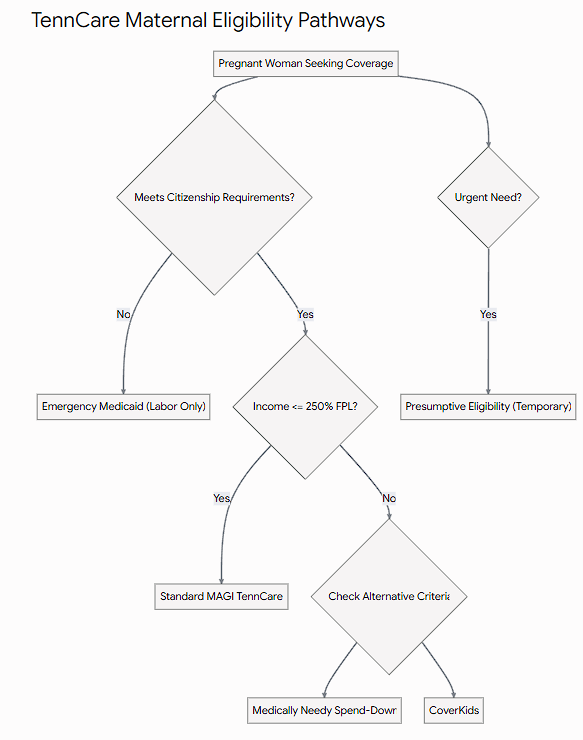
For pregnant people and new mothers in Tennessee, securing timely prenatal and pediatric care is often hindered by a fragmented and confusing health coverage landscape. Expectant mothers must navigate a complex web of overlapping programs, including presumptive eligibility, standard TennCare, CoverKids, and Emergency Medicaid. Because patients rarely understand the nuanced differences in benefits and qualifications, low-income families are forced into a confusing maze of bureaucratic requirements. Many rely entirely on the limited bandwidth of nonprofit groups or local health departments to file applications. This complexity leaves eligible individuals uninsured because they assume they do not qualify or struggle to identify and navigate which program they qualify for.
4.1 The Complexity of Eligibility Pathways
Tennessee offers multiple pathways for maternal and infant coverage, but each comes with distinct eligibility hurdles and administrative burdens that delay access to care:
Standard TennCare
Standard TennCare offers comprehensive maternity and 12-month postpartum coverage for households up to 250% of the Federal Poverty Level (FPL), while covering children up to 211% FPL.
CoverKids
CoverKids, Tennessee’s CHIP program, acts as a bridge for families in the "coverage gap" (like non-citizens or those lacking private maternity benefits). Like Standard TennCare, it provide robust, no-cost preventative care, but distinguishing between the two programs remains a major source of confusion.
Presumptive Eligibility (PE)
PE provides immediate, temporary coverage for urgent needs like unexpected pregnancies. However, its operational design creates friction: it strictly requires an in-person application at a hospital or health department. Furthermore, mothers must file a full TennCare application within one month to prevent the benefits from expiring.
Medically Needy Spend-Down
Pregnant women exceeding standard income limits can "spend down" excess income on qualifying medical expenses to gain coverage. This imposes a severe documentation burden. Mothers must meticulously track out-of-pocket costs, prescriptions, and specific deductions over a strict four-month window (the application month plus three prior months) to prove their income meets state standards.
Emergency Medicaid
Undocumented mothers ineligible for TennCare or CoverKids are limited to Emergency Medicaid. This strictly covers acute, life-threatening events—like active labor and delivery—and provides zero prenatal or postpartum care. Consequently, hospital social workers must initiate complex, retroactive applications post-delivery to prove the care met emergency definitions and secure reimbursement.
4.2 Logistical and Technical Friction
Even when mothers identify the correct pathway, significant administrative obstacles delay care. The digital divide, driven by gaps in broadband and cell coverage, hinders online applications for vulnerable populations. Navigating the enrollment process via TennCare Connect involves a daunting phone application lasting 45 to 60 minutes, plagued by confusing menus, long wait times, and requirements for existing account information. Once submitted, a standard eligibility decision can take up to 45 days—a critical delay during a pregnancy. These issues are exacerbated for non-English speakers facing language and interpreter barriers, and for those lacking reliable transportation to complete the mandatory in-person PE applications.
Crucially, even if applicants navigate the enrollment process perfectly, administrative errors by state systems and local staff still pose a significant barrier. While Tennessee does not proactively publish granular eligibility quality control data, the Comptroller’s annual Single Audits and federal Payment Error Rate Measurement (PERM) data highlight pervasive processing inaccuracies. National PERM data reveals that over 77% of Medicaid "improper payments" are strictly due to "insufficient documentation" where agencies miss administrative steps. In Tennessee, recent federal court findings confirm that the TEDS system frequently ignores existing applicant data and fails to properly assess eligibility, wrongfully terminating highly vulnerable demographics despite complete applications.
4.3 TennCare Connect and Infrastructure Gaps
Without structured education on how to utilize TennCare Connect to verify identity, update cases, or submit documents, the digital tool remains underutilized. Local administrative staff frequently lack the necessary training to navigate the portal's intricacies, limiting their capacity to support applicants.
Compounding these workflow inefficiencies is the systemic reliance on credit bureaus like Experian for identity verification on portals like TennCare Connect and Healthcare.gov. This structural design fundamentally disadvantages low-income applicants who lack established credit histories, effectively locking them out of automated digital enrollment. Consequently, applicants are forced into already overburdened operational channels—specifically backlogged call centers and in-person visits. For rural Tennesseans, these digital infrastructure failures are magnified by the significant travel times required to reach physical local offices, creating severe bottlenecks in access to maternal and infant care.
4.4 Provider-Side Constraints Impacting Physical Access
Operational barriers extend beyond patient enrollment directly into the clinical infrastructure. The current Medicaid framework places severe financial strain on healthcare providers, particularly in rural areas. Reimbursement rates—specifically the global fees paid to OBGYNs for managing a patient's entire pregnancy, delivery, and postpartum care—have remained stagnant for years and consistently fail to cover the actual cost of services. While there may be some relief on the horizon - practitioners and hospitals spent years losing money on the care they provide. This financial reality has directly contributed to the closure of labor and delivery units across rural Tennessee. Healthcare providers are also an essential assistant for helping patients navigate this complex system - and as more providers close, there are fewer resources available for navigating Medicaid. The end result is fewer residents on Medicaid with poorer healthcare access.
4.5 Managed Care Organizations and Individual Units
Compounding existing operational challenges is a structural disconnect within Managed Care Organizations (MCOs): the Medicaid infrastructure often evaluates beneficiaries as individual units rather than cohesive families. This fragments care, frequently resulting in family members being arbitrarily split across different MCO health plans or losing coverage unevenly.
5 Recommendations
5.1 Communications
- Modernize Communications: TennCare must move beyond the reliance on physical mail, which disproportionately fails families in transient housing or rural areas. Invest in better multi-lingual communications and SMS text messaging to ensure renewal notices and updates actually reach mothers. This doesn’t mean physical mail outreach ends; it needs to be supplemented.
- Clarify Naming Conventions: TennCare must address program jargon that confuses applicants. Clearly distinguish between TennCare, CoverKids, Emergency Medicaid, and Presumptive Eligibility so families understand exactly what they are enrolling in, what is covered, how to stay enrolled, and what their status is.
- Enhance Healthcare Cost Literacy: Develop transparent, accessible tools like a localized healthcare cost calculator. Equipping families with clear information about out-of-pocket expectations demystifies the system and encourages continuous engagement with care and coverage for care.
- Target Communities where Enrollment is Lagging: Gaps in enrollment are not evenly distributed across the state; TennCare should invest in local efforts in counties with high uninsured but eligible populations.
- Making Medicaid Consumer Friendly: Public engagement with Medicaid should be grounded in the real life stories and experiences of those who use it. Understanding exactly how administrative barriers directly impact the physical and mental health of Tennessee mothers and babies instead of a focus on bureaucratic process provides the urgency needed to drive systemic change.
5.2 Operations
- Deploy Community Health Workers (CHWs) and Navigators: Private philanthropy and TennCare should provide funding to support CHWs and navigators who work in Federally Qualified Health Centers (FQHCs) and local clinics. These navigators should "walk alongside" mothers through the entire process—including scheduling return visits for document uploads—so families do not get lost in the administrative shuffle or experience coverage gaps.
- Grow the CHANT Program and Evidence-Based Home Visiting: The legislature should build upon the success of the Community Health Access Navigation in Tennessee (CHANT) program and the Evidence-Based Home Visiting Program. By further funding and cross-training local health department care coordinators home visiting staff in TennCare eligibility and renewal processes, they can effectively act as administrative buffers against procedural exhaustion and bridge the enrollment gap.
- Managed Care Organizations and Families: Managed Care Organizations should transition to a family-centered enrollment and renewal model that automatically aligns all household members within the same Managed Care Organization (MCO) by default. Additionally, eligibility and data systems must be modernized to process redeterminations at the household level, ensuring changes in a parent's status do not inadvertently trigger coverage drop-offs or separate plan assignments for their children.
- Facilitate a "Warm Handoff" at the Postpartum Cliff: TennCare should treat the end of the 12-month postpartum extension as a managed transition rather than a cliff. Deploy dedicated navigators to actively transition mothers to the ACA Marketplace or Caregiver Medicaid rather than simply mailing a termination notice.
- Redesign Automated Notices: Conduct an immediate operational audit and redesign of all automated Medicaid renewal and termination notices. TennCare must ensure all generated communications are legally sound, comprehensible, and provide enrollees with the exact information essential for the maintenance of their coverage, stopping the distribution of defective notices.
5.3 Policy
- Maximize Automatic (Ex Parte) Renewals: Eliminate the procedural paperwork burden by fully integrating cross-agency data. If a mother or child is already deemed financially eligible for SNAP or WIC, the state should utilize that existing data to automatically renew their TennCare coverage at the household level.
- Implement Multi-Year Continuous Eligibility for Children: Provide uninterrupted pediatric coverage from birth to age six. This eliminates the "deemed newborn" cliff at age one and annual redetermination churn during a child's most critical developmental years, simultaneously reducing the state's administrative workload.
- Expand Presumptive Eligibility Authority: Stop treating PE as a hospital-centric "band-aid." Grant PE determination authority to trusted Community-Based Organizations (CBOs), WIC clinics, and FQHCs so the organizations mothers already trust can proactively capture uninsured pregnant women before a crisis point.
- Enable Direct Address Updates by Providers and MCOs: Address the root cause of notification failures by legally authorizing Managed Care Organizations (MCOs) and contracted healthcare providers to update a patient’s contact information directly within the TennCare system.
- Audit and Overhaul TEDS: The state must conduct a comprehensive technical overhaul of the automated Tennessee Eligibility Determination System (TEDS). The system must be updated to ensure it effectively evaluates all available data already on file and accurately screens applicants for disability-related coverage, directly addressing the systemic vulnerabilities identified in recent federal litigation.
- Mandate Data Transparency: Require the state to proactively publish granular, case-level Medicaid Eligibility Quality Control data in a consumer-friendly format. Publicly tracking deficiency and error rates is necessary to identify structural chokepoints and hold the state accountable for systemic administrative failures.
6 Conclusion
The administrative complexities of Tennessee's Medicaid system currently act as a significant barrier, separating vulnerable mothers and children from access to the continuous care they need. Whether in high poverty rural communities or wealthier suburbs, these procedural hurdles exacerbate severe health disparities and directly contribute to the state's maternal and infant health crisis.
By adopting the targeted policy and operational shifts outlined in this report, state leaders can effectively dismantle this red tape. Transforming TennCare into an accessible, consumer-centered safety net is an urgent necessity to ensure that every eligible family maintains their health coverage without falling off preventable bureaucratic cliffs.
2.2 Social Drivers of Maternal Vulnerability
By cross-referencing enrollment data with the Surgo Maternal Vulnerability Index (MVI), we can pinpoint which communities face the steepest barriers to maternal and child health and how that might compare to the eligible but unenrolled population. High MVI scores reflect systemic community-level stressors that compound the difficulty of navigating Medicaid enrollment.
When drivers such as physical environment, general healthcare access, and physical health are severely compromised, the bureaucratic requirements of maintaining health coverage become exponentially more challenging for expecting and new mothers. Importantly we also find that counties that have a greater risk for maternal vulnerability typically have lower uninsurance rates than wealthier communities with less risks for pregnant women.